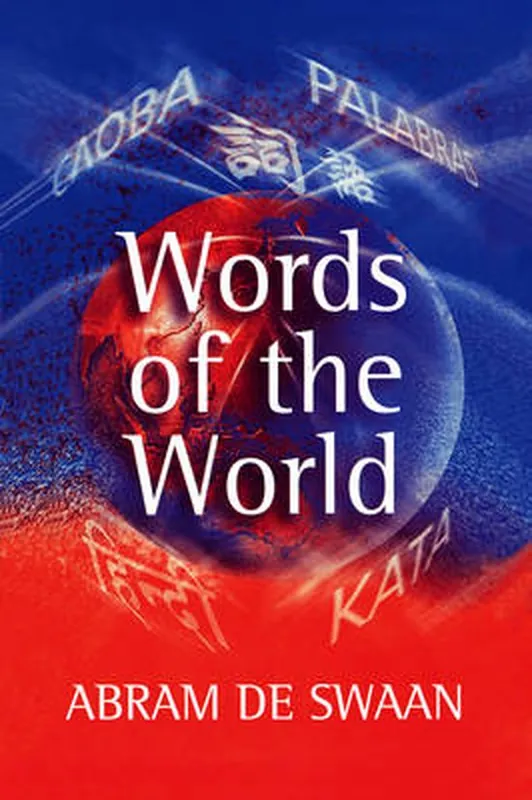

Titel: Words of the World
Schrijver: Abram de Swaan
Bindingswijze: Paperback
EAN: 9780745627489
Conditie: Goed
Staat van dit boek
Elk boek is handmatig gecontroleerd. Vragen? Stuur gerust een bericht.
Condities
Als nieuw Zo goed als nieuw, geen tot vrijwel geen gebruikssporen.
Goed Lichte gebruikssporen mogelijk, meestal geen aantekeningen.
Redelijk Zichtbaar gebruikt, kan sporen of aantekeningen bevatten.
Nieuw Ongelezen en in nieuwe staat.
Beschrijving:
This bold and accessible study of human languages and communication explores issues which are at the forefront of today’s globalized society. The human species is divided into more than five thousand language groups that do not understand each other.
This bold and accessible study of human languages and communication explores issues which are at the forefront of today’s globalized society.
The human species is divided into more than five thousand language groups that do not understand each other. And yet these groups constitute one coherent world language system, connected by multilingual speakers in a surprisingly powerful way. The chances of a language thriving depend on its position in the system. There are thousands of small, peripheral languages, each connected to one of a hundred central languages. The entire system is held together by one global language: English. A language is a ‘hypercollective’ good: the more speakers it has, the higher its communication value for each one of them. Thus, when people think that a language is gaining new speakers, that in itself is a reason for them to want to learn it too. That is why, in an age of globalization, only a few languages remain for transnational communication and these often prevail even in national societies.
This important book discusses a number of specific constellations in detail: India, Indonesia, Sub-Saharan Africa, South Africa and the European Union. De Swaan concludes by providing a sober but illuminating view of language policy in multilingual societies. This book will be essential reading for those studying sociology, communication studies and linguistics.
This bold and accessible study of human languages and communication explores issues which are at the forefront of today’s globalized society.
The human species is divided into more than five thousand language groups that do not understand each other. And yet these groups constitute one coherent world language system, connected by multilingual speakers in a surprisingly powerful way. The chances of a language thriving depend on its position in the system. There are thousands of small, peripheral languages, each connected to one of a hundred central languages. The entire system is held together by one global language: English. A language is a ‘hypercollective’ good: the more speakers it has, the higher its communication value for each one of them. Thus, when people think that a language is gaining new speakers, that in itself is a reason for them to want to learn it too. That is why, in an age of globalization, only a few languages remain for transnational communication and these often prevail even in national societies.
This important book discusses a number of specific constellations in detail: India, Indonesia, Sub-Saharan Africa, South Africa and the European Union. De Swaan concludes by providing a sober but illuminating view of language policy in multilingual societies. This book will be essential reading for those studying sociology, communication studies and linguistics.