
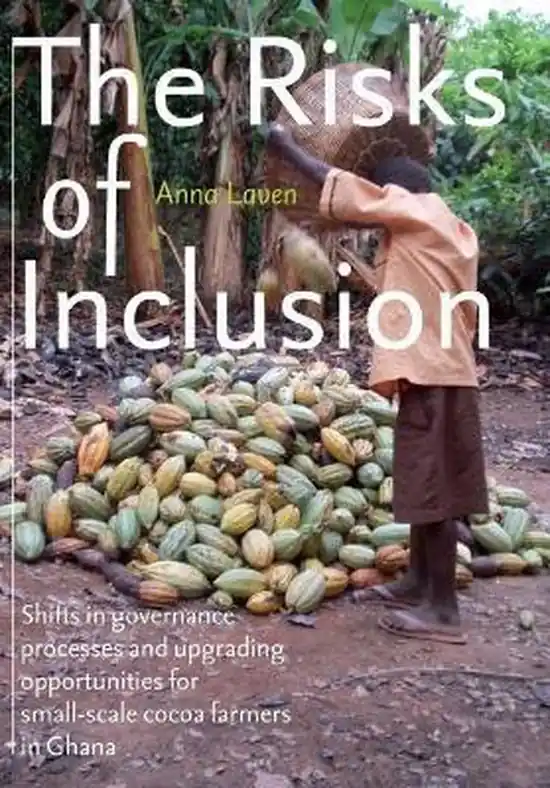

Titel: The Risks of Inclusion
Schrijver: Anna Laven
Bindingswijze: Paperback
EAN: 9789460221118
Conditie: Goed
Staat van dit boek
Elk boek is handmatig gecontroleerd. Vragen? Stuur gerust een bericht.
Condities
Als nieuw Zo goed als nieuw, geen tot vrijwel geen gebruikssporen.
Goed Lichte gebruikssporen mogelijk, meestal geen aantekeningen.
Redelijk Zichtbaar gebruikt, kan sporen of aantekeningen bevatten.
Nieuw Ongelezen en in nieuwe staat.
Beschrijving:
This book provides a detailed description and analysis of upgrading opportunities for small-scale cocoa farmers in Ghana. It shows how and why producers do, or do not, benefit from being inserted in a global value chain that is increasingly driven by multinational cocoa processors and chocolate manufacturers. The study contributes to the recent discussions on hybrid governance structures, in which both public and private actors play a role.
Ghana provides a unique case because, unlike in other West African countries, its cocoa sector is only partially liberalized. The state still plays a strong role in the cocoa market. As ”balancer”, the state mitigates some of the risks involved in cocoa production for producers and international buyers of cocoa. However, the state is also a ”bottleneck”, as it prevents other public, private and civil actors from playing a more active role in the supply chain. The study explores the processes of in- and exclusion of cocoa farmers in value chains and highlights two risks of inclusion. First, for producers the arrangements within the chain are sub-optimal, and do not create incentives for farmers to behave as entrepreneurs. Moreover, farmers do not benefit equally from the arrangements in place. Second, the state is inward oriented and lacks an adaptive approach to global market changes, which entails a risk for the sector as a whole.